Skip to content

Wikiepistemologia

Nikke jatkaa keskustelua [1, 2, 3] Wikipediasta ja sen tiedon muodosta. Näinhän se menee:

“Descartesin unelma varmasta tiedosta ei taida toteutua, sillä sellaista paikkaa ei ole, josta käsin maailmaa voisi katsoa intressittömin silmin. Sanomalehti, oppikirja ja tv-uutiset edustavat jonkun näkökulmaa, niillä on kytköksensä johonkin yritykseen tai vähintään ne edustavat tietynlaista ihmis- ja yhteiskuntakäsitystä. Wikipedia ja blogit eivät ole kiinnostuneita yhdestä näkökulmasta. Blogit voivat olla hyvinkin näkökulmaisia, Wikipedian johtavana periaatteena taas on kilpailevien näkökantojen esille tuominen samanaikaisesti. Kuka tahansa voi tuoda uuden näkökulman esille, tutustua artikkelien muutoshistoriaan ja niistä käytyyn keskusteluun.

Seuraavaksi Wikipedian toimintamalli leviää muille tiedon alueille: oppikirjoihin, uutisiin, yhteiskunnalliseen suunnitteluun, politiikkaan. Jotta tähän sisältyvä demokratian mahdollisuus toteutuisi, tarvitaan uudenlaista medialukutaitoa.”

Ehkä on siis heitettävä vielä ainakin yksi klassikkonimi kehiin, Nietzsche: “ei ole olemassa näkökulmatonta tietoa.” Pespektivismi sopii hyvin Wikipedian epistemologiaksi, vielä paremmin Wikipedioiden epistemologiaksi.

Hackerism, professionalism and paid work

The classics of Open Source anthropology, such as Raymond’s Cathedral and Bazaar and Himanen’s Hacker Ethics describe a community of highly skilled and motivated programmers, who work together because they like it, for whatever reason: having fun, learning, being clever, showing off, group identity, and so on. Like Torvalds notes in his introduction to “Hacker Ethics”, “having fun” is the highest point on the hierarchical ladder of motivations (a’la Maslow), meaning both that it is noble and that it is fragile. “Enthusiasm” is the operative word here, not effectiveness, not predictability, not superb skills. However, as ever, the argument goes that through enthusiasm “work”, especially creative action, is made better. Play and finalities, ends-in-themselves, were celebrated already by Aristotle as hallmarks of practical wisdom. Thus, effectivity, innovation, excellence may very well follow from communities of enthusiasts. This is the sense in which “hacker ethics” or the principles of OS collaboration may be extended to almost any other field, including design, curricula, and – warfare.
So what happens now, when many of the important and noteworthy OS communties are turning from communities of hobbyists into communities of paid workers, programmers who take part in the collaboration because a company pays them? This is a phenomenon confirmed, for example, in our OSSI survey: Debian is (still? forever?) a community of enthusiasts, while Eclipse is a community of paid workers (or a cluster of communities of paid workers). How is this shift going to change the anthropology and sociology of a) communities of non-hobbyists and b) the whole scene of OS collaboration? Clearly the rules of co-operation, its division and management are going to change. The funny thing is that they are going to change into something more familiar: the work ethic of market economies that can be rationalised through Taylorist principles. While free software enthusiasm and open source hobbyism were initially something of an enigma to received wisdom in software business (but: do we still have a sound economic theory explaining FOSS collaboration and productivity?), the shift from communities of hobbyists to communities of paid workers signals in a sense a return to “normal conditions”. Something is lost, something is gained.
One thing needed is a new anthropology and understanding of communities that mix hobbyists and paid workers into a hybrid. It is like trying to combine an army of volunteers with groups of mercenaries, which is not easy: the two groups march to different tunes, have different loyalties, customs, and so on. As long as the target is clear and common, the hybrid can work. However, treating hackers like they are workers may lead to problems (Mark Shuttleworth has an instructive case to report), as will treating workers like hackers. One figure that may be interesting in this respect is that of the professional in the old sense of the term. The professional is somebody who professes the more or less established best practices of a learned trade. The first “professors” were hired by groups of students by letting a hat go round. The professional in this sense is an enthusiast and a hired gun at the same time. However, her or his main allegiance lies in benefiting the trade, not in serving this or that master. The professional is his or her own master, autonomously developing his/her trade and co-operating with other autonomous agents. The career trajectory of some of the most profilic hackers seems to already point to this direction: they have certain key responsibilities for which they have to be released from their day jobs by a sponsor or a group of sponsors. Like the first univerisities grew around groups of learned professors and students, maybe we will see something like “The University of Debian” growing around some of the most vibrant and vital communities.

Nits

Derrida ei ole ainoa, joka pelleillee Nietzschen nimellä (“il veut Nice, il Venise, il veut Nietzsche”). Muistaakseni yhdessä Sopraanojen jaksossa isä-Tony ja poika-Tony sanailevat, ja poika-Tony tokaisee jotakin tyyliin: “Nits said that nothing matters”. Nietzschen ja Jumalan nokittelut toistensa kuolemasta ovat vessan seiniltä tuttuja. Artikkelissa “Shamanic Nietzsche” Nick Land esittää saman teeman hiukan lyyrisemmin:
“God said to Nietzsche
that’ll tietzsche
you irritating little krietzsche.”

Re-ethnicizing minds

Alright, I’m not a neutral observer, but I stilll think that Re-ethinicizing the minds? edited by Thorsten Botz and Jürgen Hengelbrock is an interesting book. I’m looking forward to reading it all.

Here is a portion of the description: “The predominance and global expansion of homogenizing modes of production, consumption and information risks alienating non-Western and Western people alike from the intellectual and moral resources embedded in their own distinctive cultural traditions. In reaction to the erosion of traditional cultures and civilizations, we seem to be witnessing the re-emergence of a tendency to “re-ethnicize the mind” through renewed and more or less systematic cultural revivals worldwide (e.g., “hinduization,” “ivoirization,” “sinofication,” “nipponification,” “islamicization,” “indigenization,” “russification,” “gallicization,” etc.). How do and should philosophers understand and assess the significance and impact of this phenomenon?”

Pirkanmaan Sosiaalifoorumi


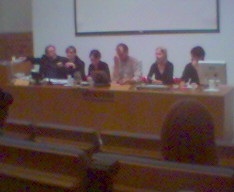
Pirkanmaan sosiaalifoorumi pidettiin helatorstaina Werstaalla. Kuvassa loppupaneelin jäseniä miettimässä seuraavan foorumin suuntaviivoja.

Osallistuin Kalle Kallion vetämään “Aktivismin kirjava menneisyys”-paneeliin, jossa kekusteltiin suomalaisen aktivismin juurista, lähtökohtana myös Metsämäen ja Nisulan tuore kirja Aktivistit. Suomalaisten kansanliikkeiden tarina (Edita, 2006). Jos on luovalla taloudella pitkät ja kiemuraiset juuret, niin on aktivismillakin. Itse sanoin jokusen sanan tolstoilaisuudesta, jossa mielestäni keskeisimmät piirteet ovat:
* lähimmäisenrakkaus
* pahan vastustamattomuus
* tämänpuoleisuus
Ensimmäinen on melko itsensäselittävä. Ajatuksena on, että egoismin ja materialismin sijaan ihmisen tulee keksittyä lähimmäistensä rakastamiseen, auttamiseen, palvelemiseen. Toinen ajatus tarkoittaa, että paha maailmasta loppuu, kun sitä lakataan tekemästä, ei niin, että sitä vastustetaan ja ajaudutaan vihollisen aseiden käyttöön eli pahaan. Tolstoille tämä tarkoitti esimerkiksi syytä olla osallistumatta valtion ja kirkon toimiin: veroja ei maksettu, virkoja ei hoidettu, valoja ei vannottu, armeijaan ei menty ja niin edelleen. Pitää rakentaa mahdollisimman itsenäisiä ja omavaraisia pienyhteisöjä. Esimerkiksi usein Gandhin suuhun laitettu lause, että miten ihmeessä muka muutama kymmenen tuhatta englantilaista pystyy hallitsemaan muutamaa sataa miljoonaa intialaista (“What does it mean that thirty thousand people, not athletes, but rather weak and ordinary people, have enslaved two hundred millions of vigorous, clever, capable, freedom-loving people? Do not the figures make it clear that not the English, but the Indians, have enslaved themselves ?”), on Tolstoin lause, kuuluisasta kirjeestä “A Letter to a Hindu“, joka herätti Gandhin ajattelemaan Intian itsenäistymistä nimenomaan intialaisena projektina, ei eurooppalaisena itsenäisyystaisteluna. Jos eduskunta esimerkiksi ratifioi Euroopan perustuslain, voisi veronmaksulakko olla hyvä reaktio. Kolmas piirre tarkoittaa, että vaikka Tolstoi sai innoituksensa erityisesti Uudesta Testametista, Jeesuksen Vuorisaarnasta, ja monelle tolstoilaiselle, kuten Arvid Järnefeltille, tolstoilaisuus oli uskonnollinen herääminen, ei hyviä tekoja tehdä siksi, että saadaan palkka seuraavassa elämässä, vaan siksi, että Jumalan valtakunta toteutuu nyt, täällä. Tolstoilaisuus ei ole täsmällinen oppi, pikemminkin käytäntöön suuntautunut elämäntapa, “kiipeäminen alas talonpojan harteilta” eli toisten työllä elämisen ja muun pahan teon lopettaminen ja maanläheisen, omavaraisen, työnjakoa vierastavan ja omasta kulttuurista nousevan elämäntavan harjoittamista.

Avoin julkaiseminen

Suomen yliopistojen rehtorien neuvosto on päättänyt allekirjoittaa nk. Berliinin julistuksen avoimesta tiedon julkaisemisesta. Mainiota!

Eläimet puhuvat

Pari mielenkiintoista juttua eläimistä ja kielestä on ilmestynyt kevään mittaan. Toisessa todetaan, että delfiinien “nimet”, jokaiselle yksilölle tunnusomaiset vihellykset, joita ne ensisijaisesti itse käyttävät itsestään, eivät perustu vain “nimen” sanojan äänen tunnistamiseen, vaan itse “nimen” ominaisuuksiin. Tutkijat tuottivat nimivihellyksiä keinotekoisesti, niin ettei nimen sanojan ääni ollut tunnistettavissa, silti delfiinit tunnistivat oman ryhmänsä “nimiä”.

Toinen koskee mainioita Cercopithecus nictitans -apinoita, joilla on eri varoitushuudot haukalle ja jaguaarille. No, nyt tutkijat ovat huomanneet, että apinat myös yhdistävät näitä huutoja tuottaen uuden merkityksen. Kolme haukkaa plus nejä jaguaaria (vai miten se nyt meni) tarkoittaa, että ryhmä lähtee liikkeelle.

Kiva, kun luonnontiede vähitellen edistyy tuloksiin, jotka ovat maalaisjärjelle ilmiselviä. Näissä kielijutuissa on aina myös lisämauste, joka koskee ihmisen kieltä. Miten erilainen se on? Nämä tutkimukset vahvistavat käsitystäni, että “Jos ihmisen ja eläimen välillä on jokin ero, sen täytyy olla olemassa jo eläimessä.” Jos ihmisen kielen ja eläinten kielen, vaikkava Cercopithecus nictitansien kielen, välillä on jokin ero, eron täytyy perustua johonkin sellaiseen, joka on jo olemassa Cercopithecusten kielessä, vaikkapa juuri huutojen yhdistämiseen erilaiseen tarkoitukseen. Muuten kielikäsityksemme on antinaturalistinen.

Open Source Warfare

Even though he might be stretching the term “Open Source” almost to a breaking point, John Robb does have some very interesting things to say about a phenomenon he calls “Open Source Warfare“. This is a phenomenon where the dynamics of open source software development are used in restructuring global guerilla warfare. Struggles are not for a unified cause, but interact in unforeseeable manner, rapidly dispersing and converging, the operations are decentralised, utilize swarm intelligence and target other networks, and their “systempunkt”, vulnerable points: especially the strategic networks of communication, electricity, oil, other valuable raw materials, etc.

One thing Robb’s intriguing analyses suggest to me, with regard to OSS and the hacker ethics is, once again, that a modus operandi does not yet say anything about the positive or negative value of what is being done. To do something in the spirit of “hacker ethics” does not by any means say that that something is “good”. I think this is something we need to keep in mind while thinking about the extremely high hopes that sometimes get attached to new emerging modes of social interaction: I’m thinking of Hardt & Negri, for instance. Scott Lash in his Critique of Information has already pointed out that networks of excellence and multitudes of particularities present a good model for different types of criminal and paramilitary action: it might even be the unofficial side of the economy that pioneers many of the most effective disorganisational techniques. A mode of organization is different from the actual content of what is being done, celebrating the former should not happen on the expense of the latter.

Free cultures

I liked Andrew Leonard’s online book on Free Software a lot, and learned from it. One entertaining feature is Leonard’s unabashed way of making broad cultural generalisations and analogues. Like “The Interner is like the bamboo, always finding a way around obstacles”. Maybe dandelions are similar. In the book Leonard also investigates the cultural and historical background that has made Finland something of a hotbed for new technology and open collaboration. He makes allusions to the past loremasters and Kalevala, the climate and the shared knowhow needed in order to weather the long winters. Interesting stuff, especially when brought together with ideas on the ethos of the welfare state.

Now Leonard is at it again, in his column “The samba and the sauna” , this time talking of Finland and Brazil. The story on Finland is the same, but in the case of Brazil free culture thrives on the hybrid, creole, mestizo “cultural cannibalism” that easily mixes and matches different cultures, styles and knowledges. Now, the funny thing is that Finland is the opposite of this: a monoculture like few others on the planet. Seems like there is no “one-size-fits-all” growing ground for open collaboration and free culture.

Puolueisiin?

Voiman uusimman numeron kansikuvapoika, Thomas Wallgren, on tehnyt mielenkiintoisen aloitteen: kriisitoimena äänioikeuden merkityksen puolustamiseksi ja kaukana kansan ja kansalaisaktivismin hankkeista liikkuvien puolueiden herättämiseksi aikaisemmin puolueisiin kuulumattomien ihmisten pitäisi ottaa jäsenkirja ja alkaa vaikuttaa myös puolueiden kautta. Wallgrenin pointti on nimenomaan “myös”: koska äänioikeus ja puolueet suurena päättävänä koneistona ovat olemassa, niitä kannattaa hyödyntää. Voiman haastattelussa Wallgren kertoo ensin päättäneensä lähteä puoluetoimintaan ja sitten valinneensa puolueen, sosiaalidemokraatit. Ei varmaan maistu kaikille, mutta perusteluja Wallgrenillä kyllä on: sosiaalinen oikeudenmukaisuus, kansanvaltaisuus, hyvä “track record” hyvinvointivaltion luomisessa. Valintahan on aina kompromissia, puolueessa toimiminen samoin.

Puoleuiden uudistaminen sisältäpäin on yksi mahdollisuus. Täytyy tunnustaa, että Wallgrenin argumentit purevat jonkun verran, ei ihan vähän. Miksi puolueet pitäisi jättää silleen? Toisaalta nykyiset puolueet ovat traditioidensa vankeja. Viettelevässä politiikassa aikoinaan leikittelimme ajatuksella, millaisia puoleita Suomeen syntyisi, jos se tapahtuisi nyt ja puhtaalta pöydältä.