Skip to content

Energikrise


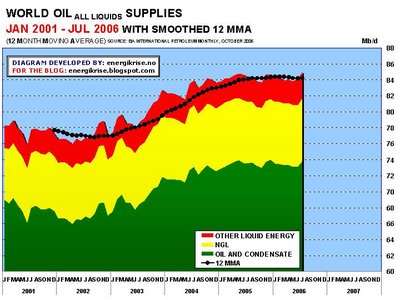
The picture is from energikrise.blogspot.com, where a bigger version can be found. There is a plateau in global oil-production, for sure. Is it the peak already? Who knows. Could very well be. Is it also the peak of global energy production?

Reading the updated version of the Olduvai-paper by Richard Duncan makes one think that yes, the peak is here. The age of industrial ccivilisation lasts ca 100 years, from 1930 to 2030. Duncan predicts that the cliff towards non-industrial developlement starts around 2008, with massive power-outs.

Two Economies, or maybe more…

Lawrence Lessig writes about two kinds of economies:

One of the most important conclusions that can be drawn from the work of Benkler, von Hippel, Weber […], and many others is that the Internet has reminded us that we live not just in one economy, but at least two. One economy is the traditional “commercial economy,” an economy regulated by the quid pro quo: I’ll do this (work, write, sing, etc.) in exchange for money. Another economy is (the names are many) the (a) amateur economy, (b) sharing economy, (c) social production economy, (d) noncommercial economy, or (e) p2p economy. This second economy (however you name it, I’m just going to call it the “second economy”) is the economy of Wikipedia, most FLOSS development, the work of amateur astronomers, etc. It has a different, more complicated logic too it than the commercial economy. If you tried to translate all interactions in this second economy into the frame of the commercial economy, you’d kill it.

Being the balanced thinker that he is, Lessig points out that there might be problems in the opposite effort of hoping that the rules of the second economy would apply to all content production. This is the argument for creative commons. There might be a point there: “the second economy” model has worked best for software, wikipedia, and science, where the definiton of an improvement is relativelyt clear for a relatively stable community. Other types of more “artistic” content may be harder, at least in some contexts.

I wonder, however, whether we should be talking of these things in terms of “economies”. Is the fact that you open the door to somebody or that you smile to a passer-by a fact of “economy”? Does not the term “economy” level down the phenomena we are talking about? Like a school of economists has pointed out, the “first” economy works only on the basis of a huge non-quantified and non-commercial sea of basic human culture & kindness that is not in any realistic sense produced or part of the “first” economy. Maybe, if want to use the term economy, we should consider the difference Bataille makes between a closed or special economy and a general economy. The lwas of special economies (“first” economy et.) work under specific favourable conditions of the general economy, as semi-isolated pockets. Thye work only in so far as they are porous enough to be sustained by the general economy, which, in any case, eventually washes away and reorganises the special economies from time to time.

Hankamäki vs. Akatemia


Jukka Hankamäki, joka opiskeli filosofiaa Tampereella samoihin aikoihin, on kaiken muun ahkeran julkaisemisensa lisäksi pistänyt nettiin kirjan mittaisen tekstin Contra Academia – Tutkielma tiedepoliittisesta vallasta. Mieleen jää karu kuva kasvottomasta ja tutkimattomasta Suomen Akatemiasta, joka mielivaltaisuutta lähentelevillä tavoilla toimii systemaattisena tieteen (tässä tapauksessa filosofian) sisältöjen suuntaajana.

Hankamäki tyylittelee menemällä henkilökohtaisuuksiin, kärjistämällä ja liioittelemalla. Mutta on asiassa vinhaa perääkin. Esimerkiksi tämä:

Kansainvälisten asiantuntijoiden antamien lausuntojen ja heidän toimintansa puolueellisuuden arvioiminen oli vielä jollakin tavoin mahdollista aikana, jolloin akatemia tilasi lausunnot kultakin asiantuntijalta erikseen. Asiantuntijat laativat siis arvionsa toistensa mielipiteistä riippumatta ja tietämättä. Tämä johti tulokseen, jossa akatemian toimikunnat saivat käsiinsä useita samaa hanketta koskevia arvioita. Niiden arvotukset poikkesivat usein voimakkaasti toisistaan. Selväksi tuli, että mikäli sama hanke sai osakseen sekä kannatusta että vastustusta, arvioihin itseensä ei voinut luottaa. Yksi ja tietty tutkimussuunnitelma on voitu arvottaa yhdestä pisteestä viiteen pisteeseen ulottuvassa järjestelmässä yhtä hyvin yhden pisteen kuin viiden pisteenkin hankkeeksi – täysin asiantuntijan henkilökohtaisista mielipiteistä, epäsympatioista tai sympatioista riippuen. Tämä johti myös akatemian oman toiminnan vaikean yhtälön eteen. Keskenään ristiriitaisista erillisarvioista oli vaikea sorvata kokoon luotettavaa kokonaisarviota, joka olisi kelvannut päätöksenteon pohjaksi. Päätöksiä ei siis voitu perustella mitenkään. Pisteytyksen määritteleminen oli nähtävissä tiedepoliittiseksi peliksi, jota se olikin.

Edellä mainitun ongelman ratkaisemiseksi akatemia muutti toimintaansa niin, että yksilöarvioiden sijasta siirryttiin käyttämään arviontipaneeleja, joissa neljä tai viisi asiantuntijaa yksissä tuumin laativat esityksensä tieteellisille toimikunnille.

Tästä on omaakin kokemusta. Muudan hakemus arvioitiin peräkkäisinä vuosina “metodisesti heikoksi” ja “metodisesti erittäin vahvaksi”, vaikka teksti ei muuttunut. Eihän siinä mitään. Mutta doublespeakkia “tieteellisestä arvioinnista”, sen objektiivisuudesta ja puolueettomuudesta vois kyllä hiukan himmata.

Odin’s companions


Odin had two ravens, Hugin & Munin, Thought and Memory, that he could send out to do his bidding. Ravens are pretty much like each others, right? So let’s say that you want to count 2 plus 2 together. You get four. Do you remember that 2+2 =4 or do you think through to the answer? How about in the case of a more complex calculation, say, 16 times 12? When you go through the calculation, maybe multiplying 16 first with 10 and then with two and the adding the sums up, as I would do, are you remembering or thinking? How would you know the difference?

I think (or do I remember?) that this has something to do with what David Bohm notes in his On Dialogue: thought is active, productive, like perception, but it presents us mostly with the end result, not with the process. Thought gives us the created, not the creation. Much like memory, one could add. Both can give us something only by leaving something out, by actively participating in the world, flying out, and reporting back. And they are good at telling about what they saw where they were asked to go, not so much about what other stuff they saw and how the route was. Maybe you have to have the capacities of Odin to ask them wisely and call them by their real names.

Debian GNU/Linux in Munich


The transition to GNU/Linux in Munich has started, delayed by patent worries by a year. First, 100 Linux terminals are taken in use and by 2008 80% of the city’s own PC’s (totalling ca. 14000) would run Linux, more specifically Debian GNU/Linux.

A detailed presentation of the project can be found here.

Sama uutinen suomeksi löytyy digitodayltä: Munchen siirtyy asteittain Linuxiin.

James Lovelock predicts…

… hard times ahead, and fast. From PastPeak:

It’s going too fast,” he says softly. “We will burn.” […]

“Our global furnace is out of control. By 2020, 2025, you will be able to sail a sailboat to the North Pole. The Amazon will become a desert, and the forests of Siberia will burn and release more methane and plagues will return.” […]

Lovelock’s conclusion is straightforward.

To wit, we are poached.

He measured atmospheric gases and ocean temperatures, and examined forests tropical and arboreal (last year a forest the size of Italy burned in rapidly heating Siberia, releasing from the permafrost a vast sink of methane, which contributes to global warming). He found Gaia trapped in a vicious cycle of positive-feedback loops — from air to water, everything is getting warmer at once. The nature of Earth’s biosphere is that, under pressure from industrialization, it resists such heating, and then it resists some more.

Then, he says, it adjusts.

Within the next decade or two, Lovelock forecasts, Gaia will hike her thermostat by at least 10 degrees. Earth, he predicts, will be hotter than at any time since the Eocene Age 55 million years ago, when crocodiles swam in the Arctic Ocean.

“There’s no realization of how quickly and irreversibly the planet is changing,” Lovelock says. “Maybe 200 million people will migrate close to the Arctic and survive this. Even if we took extraordinary steps, it would take the world 1,000 years to recover.” […]

Given the timeframe, Lovelock has started supporting nuclear power as the only viable option for drastically reducing C02 emissions. When you try to avoid the wolf, you turn towards the bear …

Isojärvellä…


… näyttää olevan vielä isoja lintuja.


Värriölläkin metsokannat ovat nousussa
, vaikka trendi ei kuulemma olekaan vielä tilastollisesti merkittävä. Toivottavasti se on kuitenkin metsojen kannalta merkittävä.

Elephants in art I


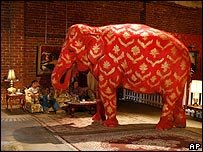
This is a great idea, but I don’t like the realisation much. The/A (?) British artist Banksy exhibits in LA a show called “Barely Legal”. It is a perfecly ordinary room, with a live elephant painted decoratively. BBC:

The animal, called Tai, was covered in pink and gold paint and placed in a mocked-up house to represent how world poverty is widely ignored.

BBC’s point is somewhat watered down by the fact that the item appears in a section called “entertainment”. Yes, there is an elephant in the house.

Civilisation as a last resort..


Recently we have heard, from Dr Diamond, for instance, that climatic and environmental change is an important reason to why cultures may collapse. But the opposite seems to be true, also. Climatologist Nick Brooks quoted by Bruce Sterling:

“‘Civilisation did not arise as the result of a benign environment which allowed humanity to indulge a preference for living in complex, urban civilised societies,’ he told the annual meeting of the British Association for the Advancement of Science.
“‘On the contrary, what we tend to think of today as civilisation was an accidental by-product of unplanned adaptation to catastrophic climate change. Civilisation was a last resort,’ he added.

This might be another thread in the larger view according to which the birth of hierarchical and stratified civilisation based on non-nomadic agriculture is not entirely a matter of “progress”. Be that as it may, Brooks argues that both in Egypt and in Mesopotamia, the birth of the early civilisations:

[t]here is widespread evidence that climatic and environmental stress played a major role in the emergence of early civilisations, and that aridification in particular acted as a trigger for increased social complexity associated with urbanisation and state formation. This paper argues that the highly urbanised, state-level societies of the sub-tropical arid belt that emerged in the middle Holocene [ca. 5000 ] did so as a result of a process of adaptation to water scarcity.

The hypothesis is that people taht were forced to move closer to the great rivers provided additional working force and ground for a societal change towards startification.

While the factors driving demographic, social and political change in Mesopotamia in the sixth and fifth millennia BP were doubtless complex and numerous, there is evidence that the wider region was subject to significant environmental change during this period, characterised by increasing aridity (Wright, 2001. p 128). It is therefore a reasonable hypothesis that water scarcity and a consequent shift of population and food production to the vicinity of major rivers was a significant factor in the evolution of
Mesopotamian society.
[…]
What does seem unambiguous is that, while
Mesopotamia is experiencing fragmentation at a time of unity in early Dynastic Egypt, in both cases cooperation and conflict are associated with the emergence of stratified state-level societies during a time of increasing aridity in the late sixth and early fifth millennia BP.

Again, like in Diamond, the idea is not that these ecological changes have anything like a necessary effect on societies. Societies react in different ways, retreating, reorganising, etc. I’m not even going to buy Brooks claim that “”When climate conditions improved again there was no return to the former order. Once the cat is out of the bag, it doesn’t go back. You can’t uninvent technology.'” Why not? Believeing in the uninventability of technology seems like a remnant of unnecessary determinism in Brooks otherwise refreshingly contrary perspective.
Open Sourcea


Oikeusministeriö on julkistanut OpenOffice-asennuskäsikirjan.
COSS kertoo, mitä kirja sisältää:

Asennusmalli käsittää seuraavat kokonaisuudet:

(1) suomenkielinen OpenOffice-perusasennus
(2) perusasennus täydennettynä käyttöasetusten säädöllä
(3) ruotsinkielisen käyttöliittymävalinnan käyttöönotto
(4) suomen kielen oikoluvun ja tavutuksen käyttöönotto
(5) vieraiden kielten oikoluvun ja tavutuksen käyttöönotto
(6) oman oletustekstipohjan suunnittelu ja käyttöönotto
(7) MultiSave-lisämoduulin käyttöönotto
(8) leikekuvakirjaston käyttöönotto
(9) ruotsinkielisen toimipisteen asennusmalli

Ja OpenTuesdayn Linux 15v-tapaamisesta löytyy videopätkä.